
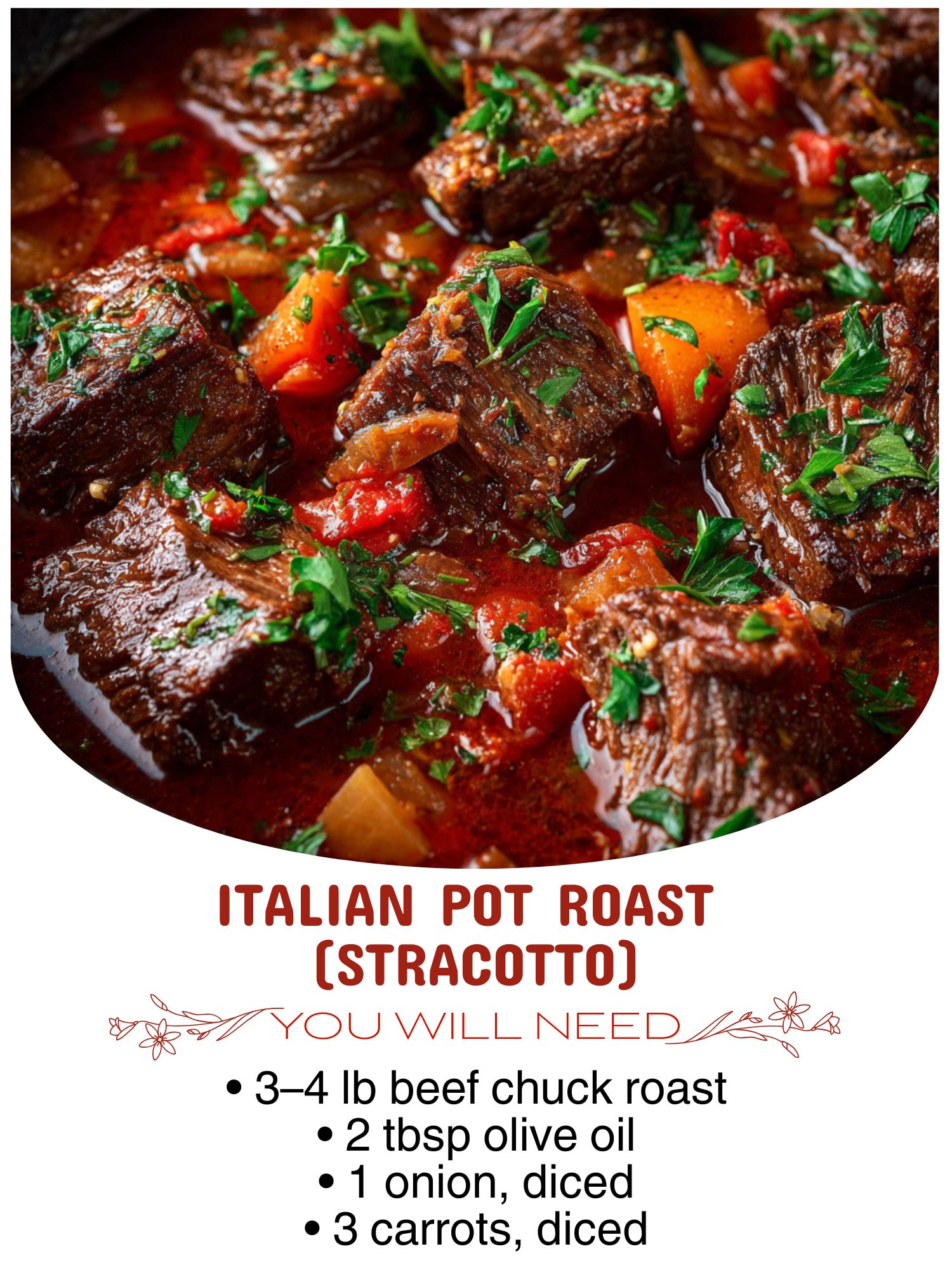
Stracotto means “overcooked” in Italian — and that’s exactly the point. This is a dish built on the philosophy that low heat, good wine, and enough time transforms a tough cut of beef into something extraordinary. Deep, wine-rich braising liquid, vegetables that melt into the sauce, and meat so tender it barely holds its shape on the fork.
This is Sunday dinner. This is the meal people remember.
Quick Info
- Prep Time: 20 minutes
- Cook Time: 3–4 hours
- Servings: 6
- Difficulty: Medium
Ingredients
For the Roast:
- 3–4 lbs beef chuck roast
- 2 tablespoons olive oil
- Salt and black pepper (generous — don’t be shy)
- 2 tablespoons tomato paste
- 4 garlic cloves, minced
- 1 large onion, roughly chopped
- 2 medium carrots, roughly chopped
- 2 celery stalks, roughly chopped
- 1 cup dry red wine (Chianti or Sangiovese preferred)
- 1 can (28 oz) whole San Marzano tomatoes, crushed by hand
- 1 cup beef broth
- 2 sprigs fresh rosemary
- 3 sprigs fresh thyme
- 2 bay leaves
- 1 teaspoon dried oregano
- Pinch of red pepper flakes
For Serving:
- Fresh parsley, roughly chopped
- Freshly grated Parmesan
- Creamy polenta, pappardelle pasta, or crusty bread
Step-by-Step Instructions
- Preheat oven to 325°F. Low and slow is the entire philosophy of stracotto — don’t rush it with higher heat.
- Season the chuck roast aggressively on all sides with salt and black pepper. More than feels comfortable — the crust that forms during searing needs strong seasoning to build real depth of flavor.
- Sear in a heavy Dutch oven over high heat with olive oil. Two to three minutes per side without touching — you want a deep mahogany crust on every surface including the ends. This step is not optional. The fond that builds on the bottom of the pot becomes the foundation of the entire sauce.
- Remove the roast and set aside. Reduce heat to medium and add onion, carrots, and celery to the same pot. Cook 5–6 minutes, scraping up the browned bits from the bottom as the vegetables release moisture.
- Add garlic and tomato paste and cook another 2 minutes, stirring constantly until the paste darkens slightly — this caramelization adds enormous depth to the finished sauce.
- Pour in the red wine and let it bubble aggressively for 3–4 minutes, reducing by about half. Don’t rush this step — cooking off the raw alcohol is essential before the long braise begins.
- Add crushed tomatoes, beef broth, rosemary, thyme, bay leaves, oregano, and red pepper flakes. Stir everything together and bring to a gentle simmer.
- Return the roast to the pot — the liquid should come about halfway up the sides of the meat. Spoon some sauce over the top.
- Cover tightly and braise in the oven for 3–4 hours, turning the meat once halfway through. The roast is done when it yields completely to a fork and practically falls apart under gentle pressure.
- Remove the roast and let it rest on a cutting board. Pull out the herb sprigs and bay leaves. Use an immersion blender to partially blend the braising liquid — or mash the vegetables with a spoon for a more rustic texture.
- Slice or pull the roast apart and return it to the sauce. Taste and adjust seasoning — a pinch of salt, a crack of black pepper, sometimes a small drizzle of good olive oil right at the end.
- Serve over creamy polenta or pappardelle with fresh parsley and Parmesan grated generously over everything.
Success Tips & Common Mistakes
Sear properly or don’t bother. A pale, lightly colored sear adds almost nothing to the final dish. You need real color — deep brown bordering on mahogany — on every surface of the roast. High heat, dry meat, and patience. That crust is where most of the flavor lives.
Use wine you’d actually drink. Cooking wine from a bottle labeled “cooking wine” is loaded with salt and additives that affect the final flavor in ways you can’t fix. A simple, affordable Chianti or any dry Italian red works perfectly — it doesn’t need to be expensive, just drinkable.
Chuck roast is the right cut. Leaner cuts like eye of round or sirloin don’t have the collagen content to break down properly during a long braise. Chuck roast has the fat marbling and connective tissue that converts to gelatin over low heat — that’s what creates that silky, coating sauce and fork-tender texture.
Resist the urge to add too much liquid. The tomatoes, wine, and broth combined with the moisture the beef releases during cooking is enough. Too much liquid produces a thin, watery braise instead of the concentrated, deeply flavored sauce that makes stracotto what it is.
Serving Ideas & Healthy Substitutions
- Serve over creamy polenta for the most traditional Italian presentation — the corn-based base soaks up that wine-rich sauce in a way pasta and bread simply cannot match
- Pair with pappardelle pasta tossed directly in the braising sauce for a complete and impressive easy family dinner that feels genuinely restaurant-worthy
- Spoon over cauliflower mash for a satisfying low carb recipe variation that carries the rich sauce beautifully without the extra carbohydrates
- The braising liquid is deeply nutritious and collagen-rich — served this way it becomes a genuinely healthy meal built around whole vegetables and quality protein
- This is one of the most efficient meal prep ideas for the week — the flavor intensifies overnight and reheats magnificently, making it perfect for portioning across multiple meals
- Shred leftover stracotto and pile it into toasted ciabatta with provolone for an incredible next-day sandwich that qualifies as a legitimate budget friendly meal when you consider how far one roast stretches
- For a gluten free dinner, serve over polenta or roasted vegetables — naturally gluten free and completely satisfying
FAQ
Can I make Italian Pot Roast in a slow cooker? Yes — complete steps 1 through 7 on the stovetop first, then transfer everything to the slow cooker and cook on LOW for 8–10 hours. Never skip the searing and wine reduction steps even for slow cooker versions — those steps build flavor that the slow cooker alone cannot create.
What if I don’t cook with alcohol? Replace the red wine with an equal amount of beef broth mixed with a tablespoon of balsamic vinegar and a teaspoon of Worcestershire sauce. The balsamic brings the depth and slight acidity that wine provides — the finished sauce is different but still deeply flavorful.
How do I store and reheat stracotto? Store meat submerged in the braising sauce in an airtight container — this keeps it moist and prevents the surface from drying out. Reheat gently over low heat on the stovetop with a splash of broth if needed. Stracotto keeps beautifully for 4 days in the fridge and up to 3 months in the freezer.
Final Thoughts
Italian Pot Roast rewards the cook who understands that some things simply cannot be hurried. The sear, the wine reduction, the long quiet hours in the oven — each step matters and each one builds on the last. What comes out of that Dutch oven after four hours is not just dinner. It is the kind of meal that makes people go quiet for a moment before they reach for more.